Solar panels for farms in Exeter
The case for solar on a Exeter holding turns on how much of the output the farm uses itself, not on how much the roof makes. The survey starts on the covering: fibre cement or steel, its remaining life, the purlin spacing and what the frame will carry.
938 kWh per kWp a year at this latitude, so a 500 kWp array models at about 469,000 kWh. Source: EU PVGIS v5.2, SARAH3, 10 degree pitch, 14 percent system loss.
Book a roof survey in ExeterIllustrative layout for a unit of this size. Your own figures come from the roof survey.
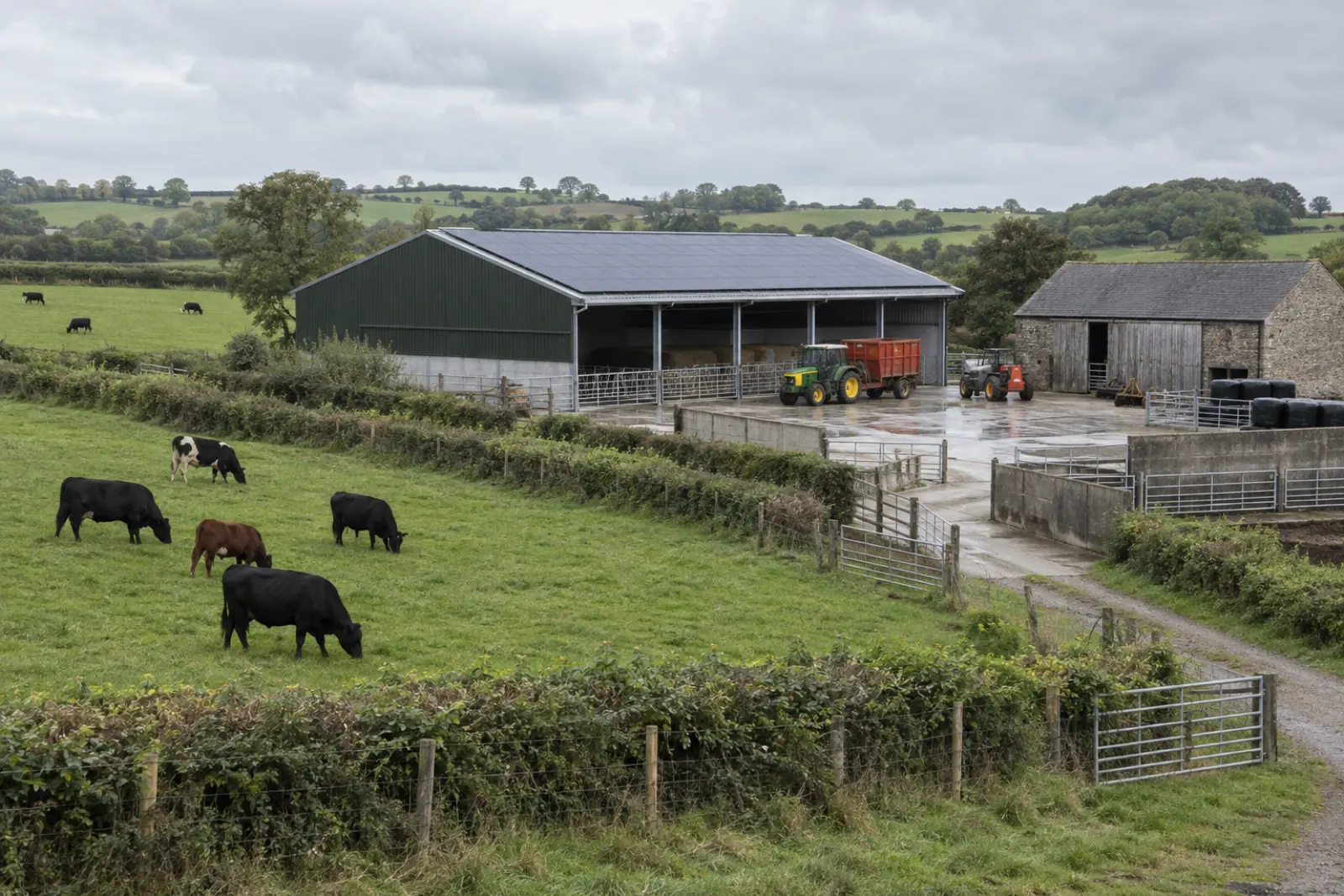
Solar for agricultural buildings across Devon
What a farm roof near Exeter generates
Modelled irradiation at this latitude is 1198 kWh per square metre a year in the plane of a shallow-pitched roof, which works out at 938 kWh for every kWp installed (EU PVGIS v5.2, SARAH3, 10 degree pitch, 14 percent system loss). That is around 6 percent above the mean across the areas we cover, which is as strong as UK farm rooftop gets outside the south coast.
The planning record lists 3 ground mounted solar schemes in this postcode district, which is a fair guide to how the local network has treated field arrays. The typical consented scheme in this district is about 5.7 MW, with the largest at 10.7 MW. Source: Renewable Energy Planning Database, Q1 2026.
3 roof mounted schemes are on record nearby. Roof arrays under a megawatt frequently never reach that database at all, so the real number of farm roofs generating around Exeter is higher than the record shows.
Surveys run across EX postcodes, EX2 outward.
Exeter is the planning authority for most holdings here, and it is the authority that decides whether an array on an agricultural building falls inside permitted development.
Exeter ranks 4 of 8 towns we cover in Devon on modelled yield, against a national mean of 886 kWh per kWp. The county runs from 903 to 961, a spread of 58 kWh per kWp. On a 500 kWp array that is about 29,000 kWh a year between the strongest and weakest town in the county.
Grid connection through National Grid Electricity Distribution
National Grid Electricity Distribution is the network operator here, and their answer on export capacity shapes the design. Any commercial array above 3.68 kW per phase connects under G99 rather than G98, and the application fixes what you are allowed to push back onto the network. If the local network is tight, limiting export rarely breaks the case here: most of the generation is consumed on site while the building is working.
Across Devon the planning database records 248 solar schemes totalling 1451 MW, of which 90 are operational (REPD Q1 2026).
Solar already consented near EX2
From the government's Renewable Energy Planning Database, Q1 2026. These are the schemes on record in this postcode district, which is a fair guide to how the local network has been treating export applications.
| Scheme | Operator | Capacity | Mounting | Status |
|---|---|---|---|---|
| Bowhay Farm | Lightsource Renewable Energy | 5.7 MW | Ground | Revised |
| Bowhay Farm | Lightsource Renewable Energy | 10.7 MW | Ground | Application Withdrawn |
| Exeter City Council - Solar Panel Array | Exeter City Council | 1.2 MW | Ground | Awaiting Construction |
| Howmet, Kestrel Way - Solar Photovoltaic Panels | Howmet Limited | 0.4 MW | Roof | Awaiting Construction |
| William Pollard & Co, Oak House - Solar Panels | William Pollard & Co Limited | 0.19 MW | Roof | Awaiting Construction |
| Matford Way, Matford - Solar Panels | Vospers Motor House | 0.23 MW | Roof | Awaiting Construction |
Send us the postcode
Tell us where the unit is and roughly how big the roof is. We come back with what it can carry, what it would generate against your consumption, and the three ways to pay for it.
Lenzie Consulting Ltd arranges the survey and passes your details to our MCS-certified installation partner so they can quote.
Questions about solar in Exeter
- How much does a farm roof near Exeter generate?
- The model gives 938 kWh for every kWp installed here, so 500 kWp comes out at about 469,000 kWh a year before shading losses. A building of roughly 1,485 sqm of clear roof carries it. Source: EU PVGIS v5.2, SARAH3, 10 degree pitch, 14 percent system loss.
- Will the rural network around Exeter take the export?
- National Grid Electricity Distribution is the distribution network operator for Devon. Anything above 3.68 kW per phase connects under G99, and the application sets the export limit. Rural supplies are often the binding constraint, so we ask the question before an array is sized.
- Is planning permission needed for panels on a farm building near Exeter?
- Usually permitted development covers a roof array. Ground mounted arrays are a different question and are far more likely to need a full application. We put both to Exeter before design sign-off.
- Has anyone near EX2 already done this?
- The planning database records 3 ground mounted and 3 roof mounted solar schemes in this postcode district. That matters less as proof it works and more as evidence of how the local network has treated export applications. Roof arrays under a megawatt often never appear in the database, so the real figure is higher. Source: Renewable Energy Planning Database, Q1 2026.