What solar panels for farms cost, and what moves the number
We are not going to put a rate per kWp on this page, because nobody can price a farm from a postcode. What this guide does instead is set out what agricultural solar costs are made of, which four things move the number on a working holding rather than on an industrial unit, and the arithmetic that turns an installed cost into a payback period you can check against your own energy bills.
no price without a survey / quote broken into lines / your own meter data
How much do agricultural solar panels cost in the UK?
Agricultural solar panels cost whatever it takes to get them safely onto your particular buildings and connected to your particular supply, so two holdings farming the same acreage a mile apart can differ by a wide margin, and the difference is almost never the solar panels themselves.
It is the roof covering, the state of the incoming supply, the distance from the building to the intake position, and what the distribution network operator will let the farm export. An agricultural solar panel cost is therefore a holding specific number, and every guide that prints one rate is describing an average rather than your yard.
Published figures for agricultural solar panels in the United Kingdom are taken across a mixed population of buildings, from new steel framed grain stores to sixty year old Dutch barns, so they describe nobody's farm in particular. We would rather give you the structure of the number than a rate you cannot rely on. Every agricultural solar panel installation quote breaks into the same six lines, and once you can see those lines you can compare two quotes properly instead of comparing two headline rates built on different assumptions.
It also lets you compare two installers on the same basis. A solar panel installer who prices a farm from a satellite image is pricing the roof they hope to find, and a panel installer who has walked the yard is pricing the one that is there. The gap between those two agricultural solar panel installation cost estimates is not a discount. It is a set of installation costs that have been left for later.
What sits inside a farm solar quote
A kWp, or kilowatt peak, is the rated output of a solar array under standard test conditions, and it is the unit every agricultural solar quotation is priced against.
A farm solar panel quote is a construction price, not a product price. What it costs to install solar panels on a farm building is mostly what it costs to get to the roof, fix to it safely and cable back to the intake position. Most of the variation between two quotes for the same grain store is in how each one handles access, the roof covering and the electrical works, not in the solar panel itself. Ask for the price broken into these six lines, because that is the only way to see what you are actually comparing.
The order matters as much as the total. A quotation that prices the solar panel and the inverter precisely and leaves access, groundworks and the connection as provisional sums has priced the easy half. Those three lines are where the money to install solar on a working holding actually goes, and they are the ones a survey exists to pin down.
Read the six lines as installation costs rather than as a shopping list. The solar panel is a traded commodity sold by the watt, so two quotes rarely differ much on it. What separates them is the labour and the equipment needed to install solar panels safely on a building that was put up to house a combine rather than to carry an array. That is where a farm solar panel price is won or lost.
Panels and inverters
Mounting
Electrical works
Access and safety
Design, survey and the grid connection
Commissioning and handover
- design and survey
- access and scaffold
- grid application
- modules
- inverters
- mounting
- electrical labour
- commissioning
Figure data
| Quotation line | Share of total |
|---|---|
| design and survey | 6% |
| access and scaffold | 14% |
| grid application | 4% |
| modules | 26% |
| inverters | 12% |
| mounting | 13% |
| electrical labour | 18% |
| commissioning | 7% |
Why system size changes the price per kWp
System size is the strongest single lever on the price per kWp, because design time, the grid connection application, mobilisation, access equipment and commissioning are close to fixed whether the solar system is 30 kWp or 500 kWp.
Spread those over more panels and the rate per kWp falls, which is why a long poultry unit usually prices better per kWp than a small machinery store on the same holding. System size is the first thing that moves agricultural solar costs, and it moves them before anyone has chosen a solar panel.
The effect is not unlimited. It flattens once the fixed costs are diluted, and it reverses if the system grows past what the incoming supply or the network operator will accept, because at that point the farm is buying a connection upgrade as well as an array. That is where the price per kWp starts climbing again, and on a rural network it climbs earlier than it does on an industrial estate.
This is also why sizing to the roof and sizing to the load give different answers. Farm roofs will usually take more panels than the holding consumes. Whether that surplus is worth installing depends on the export rate and on the energy the enterprise actually uses in daylight, which is the arithmetic further down this guide.
Figure data
| System size | Cost per kWp, indexed |
|---|---|
| 50 kWp | 100 |
| 100 kWp | 88 |
| 250 kWp | 76 |
| 500 kWp | 69 |
| 900 kWp | 66 |
| past the limit | 79 |
Fibre cement roofs and the asbestos survey
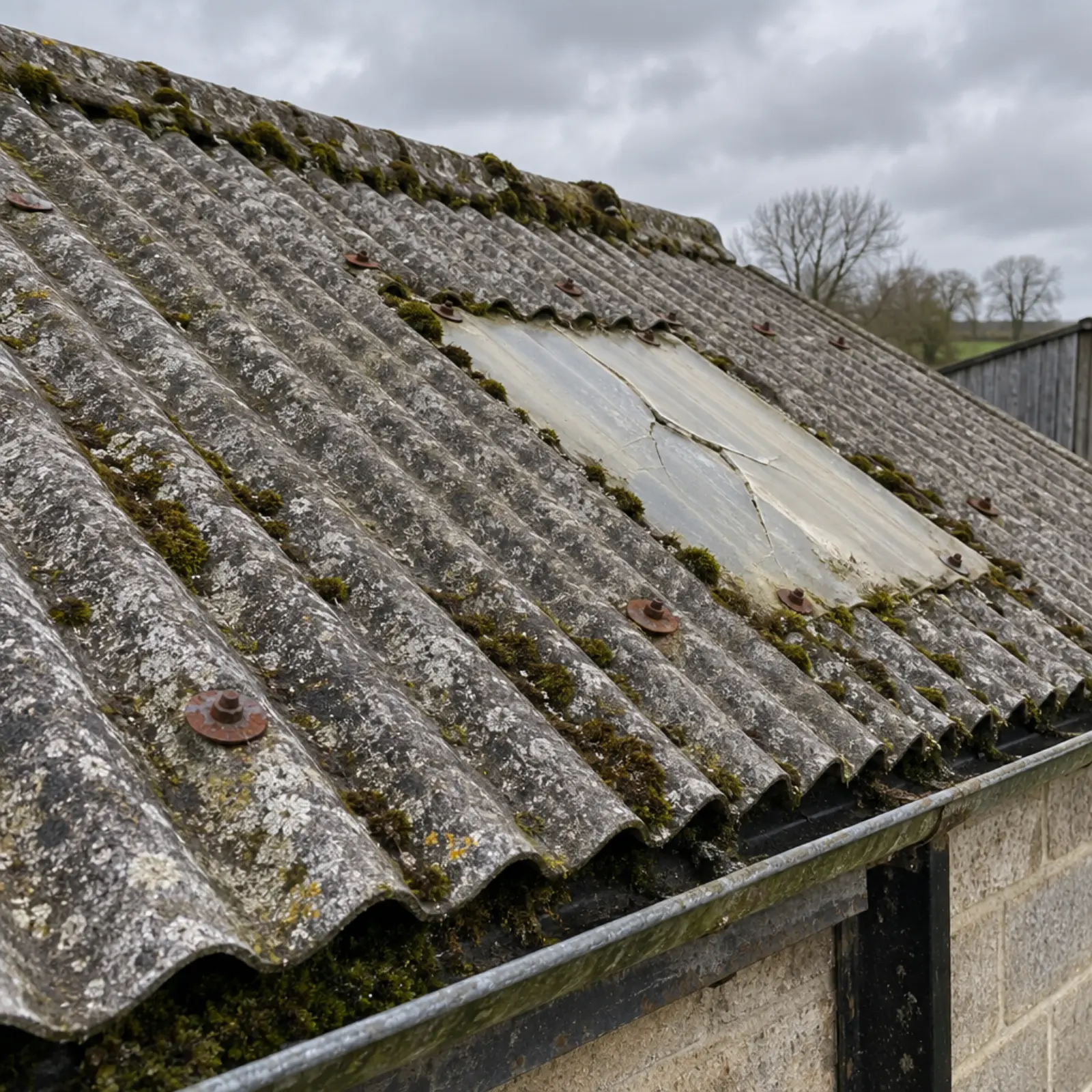
Fibre cement sheeting is the single largest swing in agricultural solar costs, ahead of the panel price and ahead of the system design, because sheet laid before 2000 may contain asbestos and has to be surveyed before anyone accesses the roof.
A refurbishment and demolition survey establishes what the covering is, and the finding drives the method statement, the mounting design and the programme. Fibre cement is also a fragile roof, so the access provision is different from a modern steel sheet even where the survey comes back clear.
The second question is remaining sheet life. A roof with ten years left carries solar panels for most of their design life. A roof with three years left means paying to remove and refit the array later, so re-sheeting first is usually the cheaper order of operations even though it reads as the expensive one on day one. Purlin centres, the spacing between the steel or timber members carrying the sheet, set the mounting design and therefore the price. Our roof survey page sets out what gets measured and why each item matters to the cost.
Three phase supply and the cable run across the yard
A three phase supply is what an agricultural solar array of any scale needs to connect into, and a great many holdings run on a single phase service sized decades ago for a house, a workshop and a milking parlour.
Where three phase is absent or weak, the distribution network operator quotes separately for bringing it in or reinforcing it, and that quotation sits outside the installer's price. It is the cost most often discovered late, and it is the reason we establish the supply position before anyone designs a system size.
The second half of the same problem is distance. Farm buildings are spread out in a way an industrial unit never is, so the run from a grain store or a poultry unit back to the intake position can be hundreds of metres of trenching, ducting and armoured cable. That is groundworks, priced by the metre and by the ground conditions, and on a spread out holding it can exceed the mounting line. Where several buildings are in play, which one carries the array is a cost decision as much as a roof decision.
Seasonal load decides the payback on agricultural rooftop solar
Self-consumption is the share of generation the holding uses on site rather than exporting, and on a farm it is decided by the season as much as by the day.
Every unit the panels make goes one of two ways. A unit you use displaces energy you would otherwise buy, so it is worth your full delivered day rate including the standing and non commodity charges on the bill. A unit you export earns the tariff your supplier offers under the Ofgem Smart Export Guarantee, which is materially lower.
Farm load is lumpy in a way commercial load is not. Grain drying runs hard for a few weeks in late summer and stops. Milk cooling and vacuum pumps run every single day at roughly the same hours. Poultry and pig ventilation tracks the weather, so it peaks in the same months the panels are most productive. A dairy and an arable holding with identical roofs and identical arrays will have very different paybacks purely because of when the load falls.
That is why we ask for twelve months of consumption data before anyone models anything. The split between self-consumption and export is measured from the meter history, not assumed from a sector average, and it is the single biggest driver of whether farm solar panels are worth it on your holding.
- generation used on site, worth your delivered day rate
- generation exported, paid at the Smart Export Guarantee rate
Shape only, with no axis numbers, because the real split comes out of twelve months of half hourly meter data rather than a sector average. A site working through daylight pushes the demand line up and the exported area shrinks. A site that goes quiet after lunch does the opposite.
Fibre cement roof sheeting
Weak or absent three phase
The cable run across the yard
Seasonal and lumpy load
Roof orientation and shading
The arithmetic, using your own figures
The payback calculation is five steps of arithmetic run on your own figures, and it is the part of this guide worth copying into a spreadsheet.
The inputs are yours rather than ours, but the method is the one a proper feasibility study uses, and it takes about ten minutes with an energy bill and a building plan in front of you.
-
System size
Usable roof area divided by the area a kWp of panels occupies. Check that second figure against any panel datasheet: divide the panel area in square metres by its rated output in kW. Take out rooflights, ridge and eaves zones, and anything the silos or the trees shade. Usable area after those come out is what converts into system size, not the gross footprint.
-
Annual generation
System size in kWp multiplied by the modelled yield in kWh per kWp for your latitude, pitch and orientation. We take that from EU PVGIS v5.2, and every county page under our locations index carries the modelled figure for that area.
-
The split
Overlay modelled generation on your own consumption, month by month rather than as an annual total, because the seasonal mismatch is the whole point on a farm. What falls under the consumption line is self-consumed. What sits above it is exported.
-
Annual benefit
Self-consumed units at your delivered day rate, plus exported units at your Smart Export Guarantee rate. Add avoided red band or capacity charges only where you can evidence them from the bill.
-
Simple payback
Installed cost divided by annual benefit. Then adjust for the tax position, for any grant funding you secure, and for whatever view you take on energy prices, stating that assumption openly rather than burying it in a spreadsheet nobody opens.
- 01
System size
[usable roof area, m2]divided by[m2 per kWp]
[your kWp]
roof plan, panel datasheet
- 02
Annual generation
[your kWp]times[kWh per kWp]
[your kWh a year]
PVGIS v5.2 for your county
- 03
The split
[your kWh a year]overlaid on[your half hourly demand]
[self consumed] and [exported]
twelve months of meter data
- 04
Annual benefit
[self consumed at your day rate]plus[exported at your SEG rate]
[your annual benefit]
energy bill, supplier SEG offer
- 05
Simple payback
[installed cost]divided by[your annual benefit]
[years]
the quotation, broken into lines
Every bracket is yours to fill. Step 03 is the one online calculators skip, and it is the step that decides the answer in step 05.
Farm, residential and commercial solar compared
Agricultural solar sits between residential solar and commercial solar on price per kWp and to one side of both of them on risk, because the scale is commercial and the buildings are not.
Residential solar panels are small systems on a house roof, installed under a domestic scheme with its own VAT treatment and its own certification. Commercial solar panels on an industrial unit are a larger array on a modern roof with a strong supply at the boundary and a short cable run. Agricultural solar takes the commercial scale and puts it on buildings that are often older, lighter, further apart and connected to a weaker network.
The practical consequence is that a farm should expect the per kWp rate of a commercial job and the survey work of a much more difficult one. Guides that compare farm, residential and commercial solar on a single rate per square metre miss the point, because the square metres are not the variable. The covering, the supply and the distance are. A residential quote is not a useful guide to a farm one either: residential solar panels are installed on a roof somebody built to a current standard, with the meter a few metres away.
The one place the comparison does help is procurement. Commercial solar panels and agricultural ones are bought from the same suppliers, at the same scale, under the same certification, so a farm should be quoted like a commercial site rather than like a large house. If a solar panel installer is quoting your grain store off a residential price list, the solar installation they have designed is the wrong one.
What a ground mounted array costs per acre
A ground mounted solar array is priced by its grid connection and its groundworks first and by its panels second, which is the reverse of how most per acre guides present it.
The distribution network operator decides what the local network can take and what reinforcement it wants paid for, and on a rural feeder that answer swings the total more than the modules do. After it come the civils: access track, trenching, piling or ballast depending on the ground, fencing and security. Solar farms of any size are largely a civils and connection job with panels on top.
That is why per acre guides to solar farms vary so widely. Two fields a few miles apart can differ by a large multiple on the same acreage because one sits beside a substation with capacity and the other does not. Ask any developer quoting solar farms what connection offer the figure assumes, and the conversation becomes a real one.
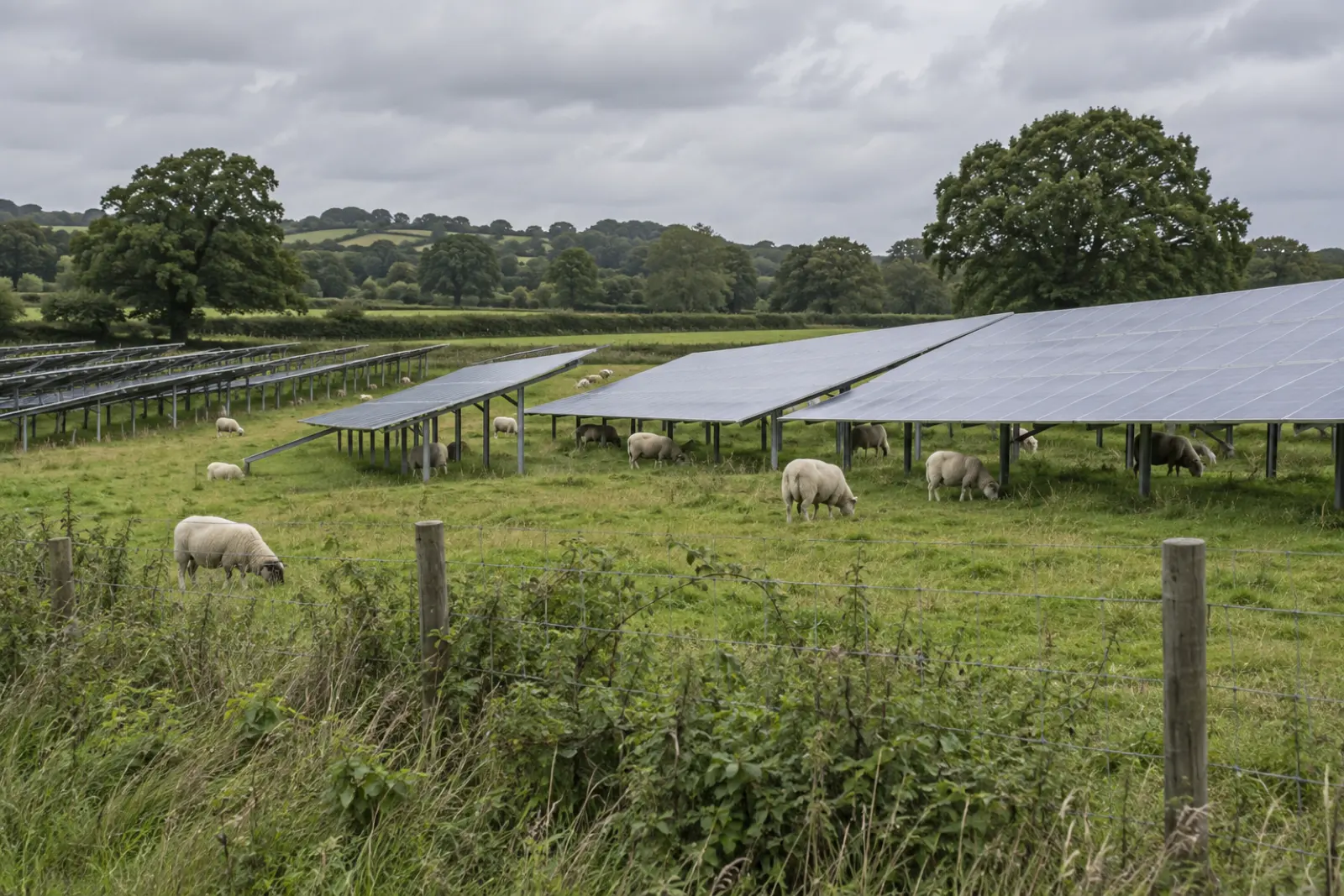
Ground mount also carries a planning route that rooftop solar usually avoids, and it takes land out of, or into shared use with, production. Where grazing or cropping continues between and beneath the rows, the arrangement is agrivoltaics, and the design changes with it. Both of those are covered properly on our pages for solar land rent and agrivoltaics.
Do you need planning permission for solar on agricultural land?
Rooftop solar on a non domestic building in England is capable of being permitted development under Class J of Schedule 2 Part 14 of the Town and Country Planning (General Permitted Development) (England) Order 2015, subject to the conditions and limits in that class.
Prior approval from the local planning authority is required above a stated capacity threshold, and the order has been amended more than once in recent years, so the current text rather than a blog summary is what to work from. A ground mounted array falls under a different class with much tighter limits, which is why anything beyond a small stand alone installation normally needs a full planning application.
Designated land, listed buildings and anything within a curtilage change the answer again, and a holding inside a National Park or a National Landscape should assume it needs a conversation rather than an assumption. We raise the planning position at survey stage because a planning answer arriving after the quotation is one of the two most common reasons a farm solar project stalls. The other is the grid connection.
Capital allowances and the after tax cost of farm building solar PV
Solar panels are plant and machinery that HMRC treats as special rate pool expenditure, and the special rate pool is the capital allowances pool carrying a lower writing down rate than main rate plant.
The guidance sits in the Capital Allowances Manual at CA22335. That classification matters because the reliefs available to special rate expenditure are not the same as those for main rate plant, and it changes the cash cost of a farm solar system in the year you buy it. The Annual Investment Allowance and the first year allowance for special rate expenditure are the two routes worth putting in front of your accountant.
We are not accountants and we will not tell you what the business can claim. We will tell you to put CA22335 in front of yours before signing anything, and to model the payback both before and after relief. A scheme that only works after tax relief is a different proposition from one that works on the energy alone. Where a partnership or a contract farming agreement is in place, who owns the array and who claims the allowances is a question to settle before the order, not after.
Where grants and funding change the sum
Grant funding changes the installed cost rather than the annual benefit, so it shortens the payback without altering any of the arithmetic above it.
One English scheme has genuinely paid for panels on farm buildings, the Improving Farm Productivity grant administered by the Rural Payments Agency, and its rounds open and close rather than running continuously. Several other farming grants people assume cover solar do not, and it is worth knowing which is which before you build a budget around one. Our solar panel grants for farmers page sets out each scheme, what it actually funds and where the source says so.
Two habits save farmers a lot of wasted effort here. The first is to check the available grants against the published eligible items list rather than against a supplier's summary of it, because the summary is usually optimistic. The second is to get the scheme surveyed and costed before a window opens, since grants of this kind are awarded on a designed proposal and the window rarely stays open long enough to produce one from scratch. Farmers who treat the available grants as a bonus on a scheme that already works are the ones who end up with both.
Where no round is open, the funding question becomes a financing question instead: capital purchase, asset finance, a lease or a power purchase agreement, each with a different answer on who owns the array and who claims the allowances. Those routes are compared on our finance page. Diversification schemes that pair solar with another enterprise are covered under farm diversification.
Is there a 20 percent rule for solar panels?
The 20 percent rule is not a rule at all: no UK legislation, no Building Regulation, no part of the distribution network connection process and no HMRC guidance contains one.
The question turns up on almost every search for solar panels on farms, so it is worth answering plainly. It circulates online as a garbled version of either an export limit, a self-consumption target or an American tax provision, and none of those is a UK rule about how much of a roof you may cover.
What genuinely limits a farm solar installation is the structural capacity of the building, the usable area once rooflights, silos and shading come out, the capacity of the incoming supply, and the export limit the distribution network operator will agree under G98 or G99. Those are the four numbers worth knowing. None of them is a fixed percentage and none of them can be established from a satellite image.
Get the numbers for your own buildings
Send the postcode and the rough footprint of the building you have in mind. The survey replaces this guide with figures for your own holding: what the roof can carry, what the supply will take, modelled generation against your consumption, and what the financing routes do to the payback on those numbers.
Lenzie Consulting Ltd arranges the survey and passes your details to an MCS-certified installation partner so they can quote. No survey fee, no obligation to proceed. We do not guarantee a saving and no figure on this page is a quotation.
Questions about agricultural solar panels cost
- How much do agricultural solar panels cost in the UK?
- Agricultural solar panels cost a holding specific number that only a survey produces, so any guide quoting a single rate without seeing your buildings is describing an average rather than your farm. The cost of agricultural solar panels is a construction cost, so it moves with the roof covering, the access, the distance from the array to the intake position and the state of the supply, not with the panels alone. Ask for the quote broken into panels, inverters, mounting, electrical works, access, the grid connection application and commissioning, then compare those lines rather than the headline. A published agricultural solar panel cost is useful as a guide to the shape of the number and misleading as a budget.
- How much does it cost to install solar panels on a farm?
- The installation cost on a farm is driven by four things that barely register on a commercial or residential job: whether the roof covering is fibre cement and therefore needs an asbestos survey before anyone goes up, whether the holding has a three phase supply strong enough to take the connection, how far the building sits from the intake position, and how lumpy the load is across the year. A modern steel framed grain store with three phase at the gable and a short cable run is the cheap end. A 1970s fibre cement livestock shed at the far side of the yard on a single phase supply is the expensive end, and the difference between them is mostly groundworks, access and the network operator, not solar panels.
- What is the 20% rule for solar panels?
- The 20 percent rule is an internet phrase rather than a UK rule. No legislation, no Building Regulation, no part of the distribution network connection process and no HMRC guidance contains one, and it circulates online as a garbled version of an export limit, a self-consumption target or an American tax provision. What genuinely limits a farm solar installation is the structural capacity of the roof, the usable area once rooflights, silos and shading come out, the capacity of the incoming supply, and the export limit the distribution network operator will agree under G98 or G99.
- Do you need planning permission to put solar panels on agricultural land?
- Rooftop solar on a non domestic building in England is capable of being permitted development under Class J of Schedule 2 Part 14 of the Town and Country Planning (General Permitted Development) (England) Order 2015, subject to the conditions and limits in that class, and prior approval from the local planning authority is required above a stated capacity threshold. A ground mounted array sits under a different class with much tighter limits, so anything beyond a small stand alone installation normally needs a full planning application. Designated land, listed buildings and curtilage change the answer again. Check the order and speak to your local planning authority before you design around either route.
- How much does a 1 acre solar farm cost in the UK?
- A per acre figure for a ground mounted solar farm is not a price anyone can quote from a map, because the two largest variables sit outside the field. The first is the grid connection: the distribution network operator decides what capacity the local network can take and what reinforcement it wants paid for, and that answer swings the total more than the modules do. The second is groundworks and access, which depend on the ground conditions, the slope and the route in. What we can say is that ground mount is priced by the connection and the civils first and by the panels second, which is the opposite of how most per acre guides present it.
- How much do farmers get for having solar panels?
- There are two different answers, and mixing them up is the most common mistake on this subject. A farmer generating for their own use gets the value of the energy they displace at their delivered day rate, plus payment for exported units under the Ofgem Smart Export Guarantee at whatever rate their supplier offers. A farmer hosting a developer's scheme on their land gets rent under an option and lease, which is a commercial negotiation rather than a published figure and varies with the connection, the site and the developer. Our page on solar land rent covers the second case.
- Does a fibre cement roof stop a farm solar installation?
- A fibre cement roof does not automatically stop an installation, but it changes the order of work and the price. Sheet laid before 2000 may contain asbestos, so a refurbishment and demolition survey has to be done before anyone accesses the roof, and the result drives the method statement. Where the sheet has ten years of life left and the survey comes back clear, mounting systems exist that spread load across the purlins rather than relying on the sheet. Where the covering is at the end of its life, re-sheeting first and mounting afterwards is usually the cheaper order of operations even though it looks like the expensive one on day one.
- Can I claim solar panels against tax as a farming business?
- Solar panels are plant and machinery that HMRC treats as special rate pool expenditure, which it sets out in the Capital Allowances Manual at CA22335. That classification decides which reliefs are in play, so the writing down position differs from main rate plant, and the Annual Investment Allowance and the first year allowance for special rate expenditure are the two routes an agricultural accountant looks at first. We are not accountants and we do not give tax advice. Put CA22335 in front of yours and model the payback both before and after relief, so you can see how much of the case depends on it.