Farm solar grants: what really funds panels on agricultural buildings
One English grant scheme has genuinely paid for solar panels on farm buildings, and several of the schemes people assume cover solar do not cover it at all. This page works through each government fund a farm business is likely to be pointed at, says plainly whether it funds solar PV, and gives the gov.uk source behind every line. What is left when the grants run out is real support of a different kind: capital allowances, VAT recovery and export income.
Contents
Which solar grants are open to farmers in England?
Government funding for agricultural solar in England has run almost entirely through one scheme, the Improving Farm Productivity grant, and the other funds a farm business gets pointed at pay for other things.
That single fact saves a lot of wasted application time. The Farming Equipment and Technology Fund is a genuine Defra scheme with hundreds of eligible items and none of them is a solar panel. Countryside Stewardship pays for environmental capital items and carries no generation items at all. Farming in Protected Landscapes funds projects against four themes rather than equipment from a list. The Rural England Prosperity Fund does name solar, but it is run by your council and it is barred from funding farming infrastructure.
The honest summary is that farm solar grants exist, they are narrower than the internet suggests, and they open and close in windows rather than running continuously. The rest of the government support for agricultural solar arrives through the tax system and through the value of the energy, which is worth more to most farm businesses over the life of the array than any grant round they are likely to catch.
It is also worth being clear about how much funding is realistically in play. Grants for solar in England have been percentage grants with a floor and a ceiling, so they improve a scheme that already works rather than rescuing one that does not. A farm business that treats grants for solar as the reason to install will spend a year waiting. One that treats them as a discount on a costed scheme will be ready when a window opens, and will improve its position either way.
Every scheme, and what it actually funds
| Support | Who it is for | What it gives | Covers solar PV | Source |
|---|---|---|---|---|
| Improving Farm Productivity grant | Farmers and horticulturalists in England. Contractors cannot apply for the solar element | Grant at 25 percent of eligible costs towards solar PV panels, batteries, inverters, utility meters, grid connections and power diverters | Yes, rooftop only | gov.uk, Improving Farm Productivity grant round 2 guidance |
| Farming Equipment and Technology Fund | Farmers, horticulturalists, forestry owners and contractors registered in England | Grant at 40 or 50 percent towards listed items under productivity, slurry and animal health and welfare | No, not on the items list | gov.uk, Farming Equipment and Technology Fund FETF 2026 |
| Farming in Protected Landscapes | Farmers and land managers in National Parks, National Landscapes and the Broads | Project funding against the climate, nature, people and place themes, assessed by the local body | Not a listed item | gov.uk, Farming in Protected Landscapes |
| Countryside Stewardship Capital Grants | Farmers, foresters and land managers in England | Capital items in six groups covering air quality, water quality, boundaries, flood management, assessment and improvements | No generation items | gov.uk, applicant's guide Capital Grants 2026 |
| Rural England Prosperity Fund | Micro and small rural businesses, through the local authority running the scheme | Capital grants, with energy saving technologies including solar panels named in the prospectus | Sometimes, not for farming infrastructure | gov.uk, Rural England Prosperity Fund prospectus |
| Sustainable Farming Incentive | Farmers in England with eligible land | Annual payments for land management actions, not capital equipment | No | gov.uk, funding for farmers, growers and land managers |
| Capital allowances | Any farming business paying corporation tax or income tax on trading profits | Tax relief on the capital cost, through the special rate pool | Yes | HMRC Capital Allowances Manual CA22335 |
| VAT recovery | VAT registered farming businesses making taxable supplies | Input tax on the installation recovered in the normal way | Yes | HMRC VAT Notice 708/6 |
| Smart Export Guarantee | Installations up to 5MW with an export meter and MCS certification or equivalent | Payment per unit exported, at a rate the supplier sets | Yes, as income | Ofgem, Smart Export Guarantee |
All checked September 2026. Schemes, windows, rates and thresholds change. Verify against the source before you rely on any of it, and take your own tax advice.
The Sustainable Farming Incentive and the rest of the 2026 picture
The Sustainable Farming Incentive pays for land management actions rather than for capital equipment, so a sustainable farming agreement will not buy an array. Its window 2 opens from September 2026 according to the gov.uk funding page, and it sits alongside Countryside Stewardship Higher Tier, which opened in September 2025, and the Farmer Collaboration Fund, whose first round opens on 1 September 2026. None of the three is a solar scheme.
That matters for planning rather than for funding. A farm business running a sustainable farming agreement, a stewardship agreement and a solar project in the same year is managing three separate timetables over the same ground and the same buildings, and the cheapest version sequences them together. It is also worth saying that these schemes improve the resilience of the business in ways solar does not, and solar improves the energy position in ways they do not. They are not competing for the same decision.
How farm grants differ from the commercial solar position
Farms are in a better position than most private businesses on this. There is no general UK grant towards commercial solar on a private company's warehouse, factory or office, so a haulage firm or an engineering works funds commercial solar panels entirely from its own capital, its own borrowing or a power purchase agreement. Agriculture has had a dedicated capital scheme that paid a quarter of eligible costs, which is more than commercial solar on an industrial estate has ever attracted.
The difference is worth knowing when you are reading general commercial solar advice, because most of it is written for businesses that have no grant route at all and therefore skips the subject. Where a farm has diversified into commercial lettings, a workshop or storage let to a third party, the commercial solar rules rather than the agricultural ones may apply to that part of the holding, and the Rural England Prosperity Fund section below is the one to read.
The Improving Farm Productivity grant is the one that funds solar PV
The Improving Farm Productivity grant is a Defra capital grant, administered by the Rural Payments Agency under the Farming Investment Fund, that has paid a fixed percentage of the eligible cost of rooftop solar PV on farm buildings in England.
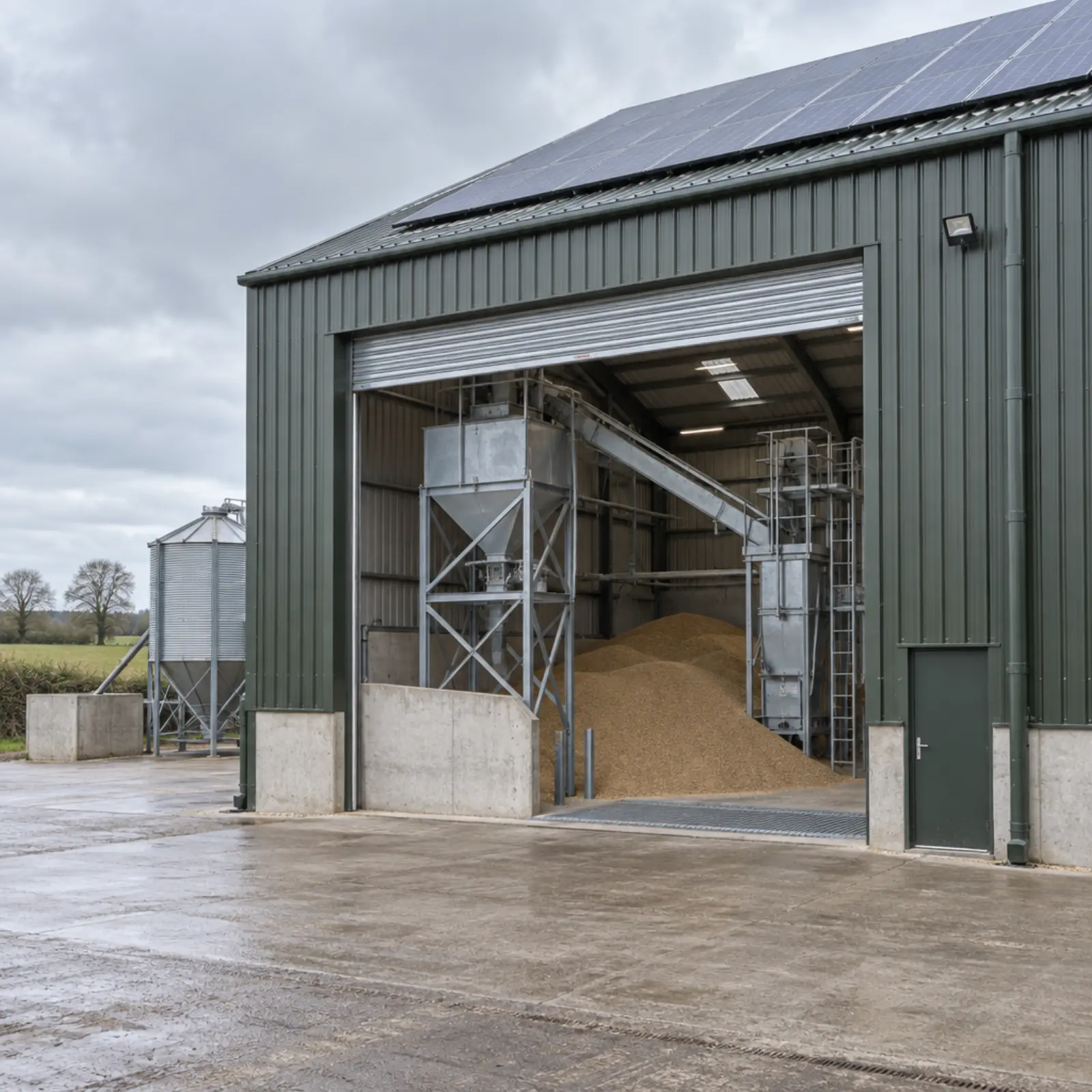
Its round 2 guidance is the clearest published statement of what a solar grant for farmers covers. Eligible items were solar PV panels, solar batteries, inverters, utility meters, electrical grid connections and power diverters. The panels had to go on farm building rooftops, or on an irrigation reservoir including the supporting floating cradle, and the system had to be mainly for farm power rather than for a residential property.
The money worked as a percentage with a floor and a ceiling. The grant paid 25 percent of eligible costs, the minimum grant was £15,000, which represents 25 percent of £60,000 of eligible costs, and the maximum was £100,000 per applicant business. Where a business combined solar with other farm productivity grants, the total across all applications could not exceed £500,000. The grant funded assets had to be located in England.
Four exclusions do most of the work in practice, and they are the reason a lot of farms find they do not qualify. The grant did not fund a ground based solar array, it did not fund replacement of existing solar PV panels, it did not fund panels on a north facing or heavily shaded roof, and contractors were not eligible to apply for the solar PV funding at all.
The scheme is widely shortened to the IFP grant, and an IFP grant application is the only English route that has put public money directly into panels on a farm roof. That is why so many pages about grants for solar on farms end up describing it, and why it is worth reading the guidance itself rather than a summary of it.
Round 2 applications are closed, and as at September 2026 the gov.uk funding for farmers page does not list a further round as open. We say that plainly rather than implying a live window, because the most common way a farm solar project goes wrong is a budget built around an award that was never available. If a round reopens, the practical point is that an application needs a costed, designed scheme and a quote, which takes longer to produce than a window usually stays open.
What the Farming Equipment and Technology Fund actually covers
The Farming Equipment and Technology Fund (FETF) is a Defra grant towards items from a published list, and solar photovoltaic generation equipment is not on that list.
FETF 2026 ran three themes: productivity, slurry, and animal health and welfare. A farm, horticultural or forestry business registered in England, or a contractor serving those sectors, could apply for a grant of between £1,000 and £25,000 for each theme, paid at 40 or 50 percent of either the expected average cost of the item or the actual cost paid, whichever was lower. The application window closed at midday on 12 May 2026.
It is worth understanding FETF properly rather than dismissing it, because it is the farming equipment grant most farms will actually use, and because it is the fund most often confused with a solar grant. The confusion is understandable: the two schemes sit inside the same Farming Investment Fund family, both are administered by the Rural Payments Agency, and both are described as productivity funding. They fund different things. FETF buys equipment from a list. The Improving Farm Productivity grant funded larger capital projects including solar.
If a supplier tells you a solar quote can be put through the Farming Equipment and Technology Fund (FETF), ask them to show you the item number on the published eligible items list. There is not one. Used for what it does cover, FETF is a sensible way to improve a specific piece of kit, and several of its productivity items reduce the energy a building uses, which is a genuine and sustainable thing to do alongside an array rather than instead of one.
Farming in Protected Landscapes and the four themes
Farming in Protected Landscapes is a Defra programme, delivered by National Park, National Landscape and Broads teams, that funds projects by farmers and land managers inside those designated areas against the themes of climate, nature, people and place.
It is not an agri-environment scheme and it does not work from an equipment list, which is why it cannot be answered with a straight yes or no on solar. You discuss a project with your local protected landscape body, they provide the application form, and applications are scored on outcomes, value for money, sustainability and legacy, and the likelihood of delivery. Applications over £10,000 go to a local assessment panel.
Two features of the funding rate matter to anyone asking about grants for solar under it. The programme can fund up to 100 percent of project costs where no commercial benefit accrues, and where a project does produce a commercial benefit the funding is proportionate to that benefit. An array that cuts your own running costs is a commercial benefit by any reading, so a solar element would be funded at a reduced rate if the local board supported it at all. The published guidance does not list renewable energy or solar PV as an eligible item.
The eligibility is geographic and occupational rather than sectoral. If you farm inside a National Park, a National Landscape or the Broads, it is worth a conversation with the local team before you commit to a scheme, particularly where the solar sits inside a wider project with genuine climate and place outcomes. The programme runs until March 2029, with applications closing earlier if the funding is exhausted.
What Countryside Stewardship capital grants pay for
Countryside Stewardship capital grants pay for environmental capital items in England, and the offer contains no solar PV, renewable energy or electricity generation items.
The applicant's guide for Capital Grants 2026 sets out six item groups: air quality, assessment, boundaries, trees and orchards, improvements, natural flood management, and water quality. Across those groups there were 80 capital items, all of them environmental management items. Four groups carried maximums, at £25,000 for air quality, £35,000 for boundaries, trees and orchards, £25,000 for natural flood management and £25,000 for water quality, while assessment and improvements had no limit. The Rural Payments Agency administers it and it applies to England. Capital Grants 2026 is closed for applications.
Countryside Stewardship still matters to a solar decision, just not as a source of grants for solar. Roofing an existing slurry store is an air quality item in the same family of grants, and a farm carrying out a capital programme under stewardship in the same year as a solar installation needs to sequence the two so that access equipment and groundworks are not paid for twice. That is a scheduling saving rather than a grant, and it is the only sense in which countryside stewardship and agricultural solar meet.
Source: gov.uk, applicant's guide Capital Grants 2026, checked September 2026.
Where the Rural England Prosperity Fund fits
The Rural England Prosperity Fund is capital funding delivered by local authorities to micro and small businesses in rural areas, and its prospectus names solar panels among the energy saving technologies a grant can support.
That makes it the one fund on this page a farm business might use for an array without a Defra window being open. The prospectus provides for capital grants towards investments in energy saving and efficiency technologies including solar panels, battery storage, heat pumps, insulation and small scale wind turbines, and separately for net zero infrastructure for rural communities including community energy schemes.
There is a significant limit. The fund provides for small scale investment in micro and small enterprises where this supports farm business diversification into activities outside agriculture, and it must not be used to fund farming equipment or infrastructure, or to diversify within agriculture. In practice that means a solar array serving a diversified enterprise, a holiday let, a farm shop, a workshop let to a rural business, is arguable, while an array serving the grain store is not.
Because each local authority designs and runs its own scheme within the prospectus, there is no single national application, rate or cap. Your district or county council's economic development team is the place to ask, and they will also tell you whether their allocation is spent. If you are weighing a diversified enterprise alongside the solar, our farm diversification page covers that decision.
Who is eligible for a solar panel grant on a farm
Eligibility for agricultural solar grant funding turns on four tests: where the array goes, what it powers, who is applying, and how large the eligible cost is.
The two sides below are drawn from the published Improving Farm Productivity guidance rather than from general principles, because that is the scheme whose rules actually decide the question for most farms. Read them as the shape of the test rather than as a live window.
- You farm or grow in England and a round of the Improving Farm Productivity grant is open, with the array going on a farm building roof mainly for farm power
- Your eligible solar costs are large enough to clear the scheme minimum, because the grant is a percentage and the floor is set in pounds
- You farm inside a National Park, a National Landscape or the Broads and your local team will consider renewable energy under the climate theme
- You are diversifying into a non agricultural enterprise and your local authority runs a Rural England Prosperity Fund energy grant
- You want a ground based solar array, which the Improving Farm Productivity guidance excludes
- You are replacing existing solar PV panels rather than installing new capacity
- The roof is north facing or heavily shaded, which the same guidance rules out
- You are a contractor rather than the farming business, or the array is for a residential property
The minimum grant deserves a word of its own, because it excludes more applicants than any of the stated exclusions. A scheme paying 25 percent with a £15,000 floor requires £60,000 of eligible costs before an application is possible at all. A modest array on a single machinery store will not reach it. That is the arithmetic that decides whether a grant is even a question for your holding, and it is why we size and cost the scheme first and look at funding second.
Capital allowances on farm solar
Why solar sits in the special rate pool
The special rate pool is the capital allowances pool that holds expenditure on integral features of a building, HMRC treats solar panels as integral features, and an agricultural array therefore goes into it rather than into the main pool.
That classification is the single most important tax fact about a farm solar system, because it decides which allowances and which rates are in play. It applies whether the business is a limited company, a partnership or a sole trader, though the relief lands against different taxes.
What that means for the year of spend
Special rate expenditure can be covered by the Annual Investment Allowance, subject to the limit and to whatever else the business has already spent on qualifying assets in the same period. That last point catches farms more than most, because a year with a new telehandler, a grain dryer and an array in it can use the allowance up before the solar invoice arrives. Anything beyond the allowance is written down at the special rate over subsequent years. We do not calculate relief and we are not qualified to.
Who claims when a funder owns the array
The allowances follow ownership. Buy outright, or through a loan or hire purchase, and the claim is normally the farming business's own. Take an operating lease or a power purchase agreement and the funder owns the asset, claims the allowances and prices that benefit into what it charges. Where a contract farming agreement or a partnership sits over the holding, agree who owns the array before the order.
- the spend
Capital cost of the array
Design, equipment and installation. Capital expenditure, not a revenue expense, so it is not written off in one line in the profit and loss account.
- classified
An integral feature of the building
HMRC treats solar panels as integral features. That single classification decides which allowances and which rates are in play.
- pooled
The special rate pool
The capital allowances pool that holds expenditure on integral features, rather than the main pool.
Annual Investment Allowance
Special rate expenditure can be covered by it, subject to the limit and to whatever else the company has already spent on qualifying assets in the same period.
Written down at the special rate
Whatever the Annual Investment Allowance does not cover is carried in the pool and written down over subsequent years.
If a funder owns the array, under an operating lease or a power purchase agreement, the funder claims the allowances instead and prices that benefit into what it charges you.
We do not calculate relief and we are not qualified to. The figure is specific to your company's profits and capital programme, so give the quotation to your accountant.
VAT on solar panels for a farm building and a farmhouse
The zero rate for energy saving materials is a VAT relief that applies to installations in residential accommodation and in buildings used for a relevant charitable purpose, which splits a farm in two.
A farmhouse is residential accommodation. A grain store, a livestock shed, a packhouse or a machinery store is not, so an array on a farm building carries VAT at the standard rate. That distinction catches people out, because a neighbour's domestic installation and your agricultural one are genuinely treated differently by the same notice.
For a VAT registered farming business making taxable supplies, the standard rated VAT on the farm building array is recovered as input tax in the normal way, which makes it a cash flow question rather than a cost. Where the holding includes a farmhouse, a let cottage, a diversified enterprise or any non business use, the apportionment needs proper advice.
What the Smart Export Guarantee pays for exported units
The Smart Export Guarantee, administered by Ofgem, requires larger licensed electricity suppliers to offer a tariff for units a generator exports to the grid.
Solar PV is an eligible technology, installations up to 5MW can take part, payments are calculated from export meter readings, and the suppliers rather than the government set the rate, the contract length and the other terms. Ofgem requires tariffs to be above zero and sets no national figure, so any page quoting a fixed rate is guessing and shopping around is part of the job.
Export rates sit well below what a farm pays to import, which is why the survey works so hard on the consumption side. A holding that uses most of its generation on site is displacing expensive imported energy at the full delivered rate. A holding that exports heavily is selling cheaply. The Smart Export Guarantee improves a scheme. It rarely makes a weak one work, and on a farm with a strongly seasonal load it is the export months that decide how much of the output ends up at the lower rate.
- VAT The zero rate for energy saving materials covers residential accommodation and buildings used for a relevant charitable purpose, so a commercial building is charged at the standard rate. A VAT registered business making taxable supplies recovers it in the normal way, which makes it a cash flow question rather than a cost. Charities, mixed use buildings and partly exempt businesses need proper advice.
- Capital allowances Solar sits in the special rate pool. The Annual Investment Allowance can cover special rate expenditure, subject to the limit and to whatever else the company has already spent on qualifying assets in the same period. Whatever it does not cover is written down at the rate in force over subsequent years.
- The energy itself Units used on site displace the price you pay to import. Units exported earn the Smart Export Guarantee rate the supplier sets, and suppliers compete on it, so there is no single national figure. This is the strand that runs for as long as the array does.
If a funder owns the array, under an operating lease or a power purchase agreement, the capital allowances lane is the funder's rather than yours.
- value coming back to the business
- cash going out first
The same figure as a table
| Support | When it lands | What happens, and on whose terms |
|---|---|---|
| VAT | on the invoice | Charged at the standard rate, because a commercial building is neither residential accommodation nor used for a relevant charitable purpose. |
| VAT | on the VAT return | Recovered as input tax in the normal way by a VAT registered business making taxable supplies. A cash flow question rather than a cost. |
| Capital allowances | in the year of spend | The Annual Investment Allowance can cover special rate expenditure, subject to the limit and to what else the company has already spent on qualifying assets that period. |
| Capital allowances | in later periods | Whatever the Annual Investment Allowance does not cover stays in the special rate pool and is written down at the rate in force over subsequent years. |
| The energy itself | every year it generates | Units used on site displace the price you pay to import. Exported units earn the Smart Export Guarantee rate the supplier sets, and there is no single national figure. |
| If a funder owns the array | for the term | Under an operating lease or a power purchase agreement the funder owns the asset and claims the capital allowances, and prices that benefit into what it charges you. |
How much farmers get for solar panels on their land
Rent for hosting a developer's solar scheme is a commercial negotiation between a landowner and a developer, not a published rate, and it is a different question from what generating for your own use is worth.
The first case is a lease. A developer takes an option over the land while it works up the grid connection and the planning application, then a long lease if the scheme proceeds, and the rent it can pay is driven by what the connection allows and what the scheme earns rather than by the acreage on its own. Anyone quoting a single per acre figure for the whole of England is quoting an average of very different deals.
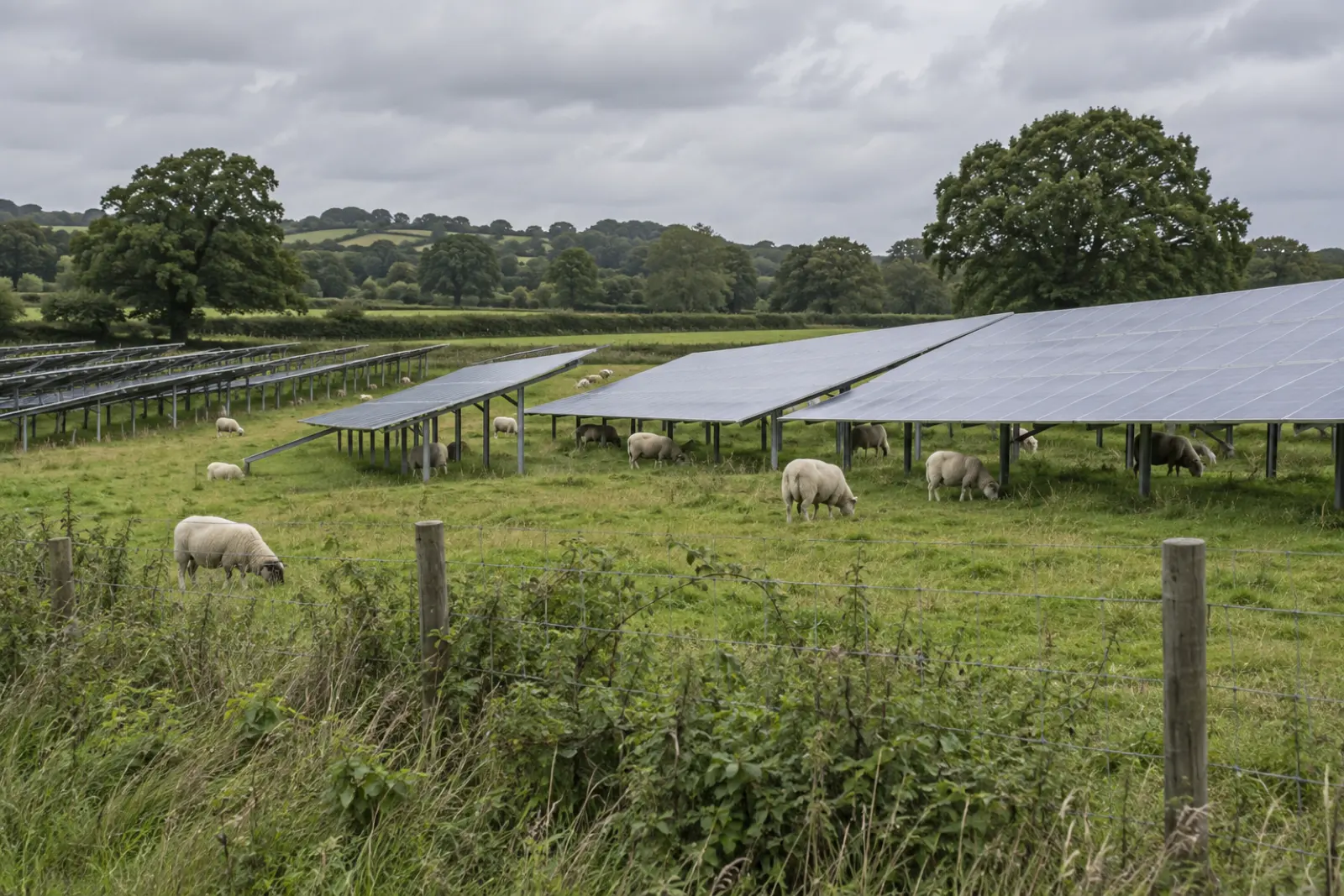
The second case is generation for the holding itself, where the value is the energy you stop buying plus the export income above. That is the calculation our cost and payback page sets out step by step. The two are not alternatives on every farm, because a rooftop array serving the yard and a ground mounted scheme on a field a mile away can sit alongside each other, but they are answered by different arithmetic. The lease side is covered on our solar land rent page, and where cropping or grazing continues between the rows, on our agrivoltaics page.
Scotland, Wales and Northern Ireland have their own routes
Agricultural funding is devolved across the United Kingdom, so every English scheme on this page stops at the border and the equivalents are set separately by each administration.
In Scotland, rural funding runs through the Scottish Government's Rural Payments and Services, and Business Energy Scotland provides advice and a loan product to small and medium sized businesses. In Wales, Welsh Government rural funding runs through Rural Payments Wales, with Business Wales as the general business support route. In Northern Ireland, the Department of Agriculture, Environment and Rural Affairs runs farm support.
We deliberately do not list open windows for those administrations here. They change faster than any website updates, and a page telling a farmer a closed scheme is open costs them more than a page that sends them to the source. Check the relevant administration directly, and treat any commercial page listing devolved farming grants as out of date until proven otherwise, including this one.
How we quote when no grant round is open
A farm solar decision with no grant window pending comes down to measured figures rather than to an application, because there is nothing to wait for.
We survey the buildings, establish what the roofs can carry and what is genuinely usable once rooflights, silos and shading come out, check the supply position, and model generation against your own consumption across the year rather than as an annual total. That produces a capital cost, a split between energy you displace and energy you export, and a payback you can defend to a bank or to a partner. The roof survey is free and it is the document you keep, whoever ends up installing.
It is also, usefully, most of what a grant application needs. If a round of the Improving Farm Productivity grant reopens, a farm with a costed and designed scheme in a drawer is in a position to apply and a farm without one is not. From there the funding conversation is about routes rather than awards: capital purchase against asset finance, a lease or a power purchase agreement, each with a different answer on who owns the array and who claims the allowances. Those are compared on our finance page.
Lenzie Consulting Ltd arranges the survey, the design and the installation through an MCS-certified partner. We are not authorised or regulated by the Financial Conduct Authority and we do not give financial, tax or legal advice. We are not grant agents and we do not submit applications. Finance introductions are to unregulated business lending. Farm businesses should take their own tax and legal advice before committing.
Find out what your buildings are worth without a grant
Send the postcode and the rough footprint. We come back with what the roofs can carry, what they would generate against your consumption across the year, and what the capital cost looks like once the allowances your accountant confirms are taken into account.
No survey fee and no obligation to proceed.
Questions about solar panel grants for farmers
- Who is eligible for solar panel grants?
- Eligibility for a solar panel grant in England has run through the Improving Farm Productivity grant, administered by the Rural Payments Agency. Its published round 2 guidance opened the solar element to farmers and horticulturalists in England, required the system to be mainly for farm power, required the panels to go on farm building rooftops or on an irrigation reservoir including its floating cradle, and excluded contractors, residential property, ground based arrays, replacement of existing panels and roofs that are north facing or heavily shaded. The grant funded 25 percent of eligible costs, with a minimum grant of £15,000 and a maximum of £100,000 per business. Rounds open and close, so check the gov.uk funding for farmers page for the current position before you plan around it.
- What farming grants are available in 2026?
- As at September 2026 the gov.uk funding for farmers, growers and land managers page lists Farming in Protected Landscapes as open all year, Countryside Stewardship Higher Tier as open, the Sustainable Farming Incentive window 2 as opening from September 2026, and the Farmer Collaboration Fund round 1 as opening on 1 September 2026. It lists the Farming Equipment and Technology Fund, Capital Grants 2026, the Improving Farm Productivity grant round 2, the Water Management Grant and the Slurry Infrastructure Grant as closed. None of the schemes currently open is a solar panel grant. Windows move, and that page is the one to check rather than any third party round up including this one.
- Does the Farming Equipment and Technology Fund pay for solar panels?
- The Farming Equipment and Technology Fund does not pay for solar panels. The 2026 fund ran three themes, productivity, slurry and animal health and welfare, with grants between £1,000 and £25,000 for each theme at 40 or 50 percent of the expected average cost or the actual cost paid, whichever is lower, and its published eligible items lists contain no solar photovoltaic generation equipment. The FETF 2026 application window closed at midday on 12 May 2026. It is a genuine Defra scheme and a useful one for the equipment it does cover, but a solar quote is not an FETF application.
- Can Countryside Stewardship fund solar panels on a farm?
- Countryside Stewardship capital grants do not fund solar panels. The applicant's guide for Capital Grants 2026 sets out six item groups: air quality, assessment, boundaries, trees and orchards, improvements, natural flood management, and water quality. The 80 capital items in the offer are environmental management items, and none of them is a generation item. Group maximums were £25,000 for air quality, £35,000 for boundaries, trees and orchards, £25,000 for natural flood management and £25,000 for water quality, with no limit on assessment and improvements. The Rural Payments Agency administers it in England, and the 2026 round is closed for applications.
- How much do farmers get for having solar panels on their land?
- There are two answers and they are frequently confused. A farmer who generates for their own use gets the value of the energy displaced at their delivered day rate, plus payment for exported units under the Ofgem Smart Export Guarantee at whatever rate the supplier offers, and Ofgem requires those tariffs to be above zero but sets no national figure. A farmer hosting a developer's scheme gets rent under an option agreement and then a lease, usually for a long term, and that rent is a commercial negotiation driven by the grid connection, the site and the developer rather than by acreage alone. Our solar land rent page deals with the second case properly.
- Is there VAT relief on solar panels for a farm?
- The zero rate for energy saving materials applies to installations in residential accommodation and in buildings used for a relevant charitable purpose, and HMRC sets out the conditions in VAT Notice 708/6. A farmhouse is residential accommodation. A grain store, a livestock shed or a packhouse is not, so an array on a farm building carries VAT at the standard rate. Where the farming business is VAT registered and makes taxable supplies, that VAT is recovered as input tax in the normal way, which makes it a cash flow point rather than a cost. Mixed use buildings and any part of the holding used for non business purposes need proper advice, because the notice draws lines a salesperson will not have read.
- Are there free solar panels for farmers?
- Free solar panels for farmers is a marketing phrase rather than a scheme. What sits behind it is usually one of three things: a rooftop power purchase agreement, under which a funder installs and owns the array at no capital cost to you and sells you the energy at an agreed rate for a long term; a green business loan, which is repayable with interest; or a lead generation page using the word grant to mean something else. A power purchase agreement is a real and sometimes sensible route, and it is compared against outright purchase and asset finance on our finance page. It is not free, because the funder takes a margin on the energy for the life of the agreement.
- Do Scotland, Wales and Northern Ireland have their own farm solar grants?
- Agricultural funding is devolved, so the English schemes on this page do not apply outside England and the equivalents change independently. In Scotland the route is the Scottish Government's rural funding through the Rural Payments and Services site, alongside Business Energy Scotland for advice and lending. In Wales it is Welsh Government rural funding through the Rural Payments Wales service and Business Wales. In Northern Ireland it is the Department of Agriculture, Environment and Rural Affairs. We do not list open windows for those administrations here because they move faster than any website updates, and a page that lists a closed scheme as open is worse than no page at all.