Solar panels for farms in Cambridge
Farm buildings around Cambridge carry broad, shallow roofs that were put up for storage and stock, not for generation. Each survey records the sheet type and condition, the usable area once rooflights and vents come out, and whether the supply is single or three phase.
906 kWh per kWp a year at this latitude, so a 500 kWp array models at about 453,000 kWh. Source: EU PVGIS v5.2, SARAH3, 10 degree pitch, 14 percent system loss.
Book a roof survey in CambridgeIllustrative layout for a unit of this size. Your own figures come from the roof survey.
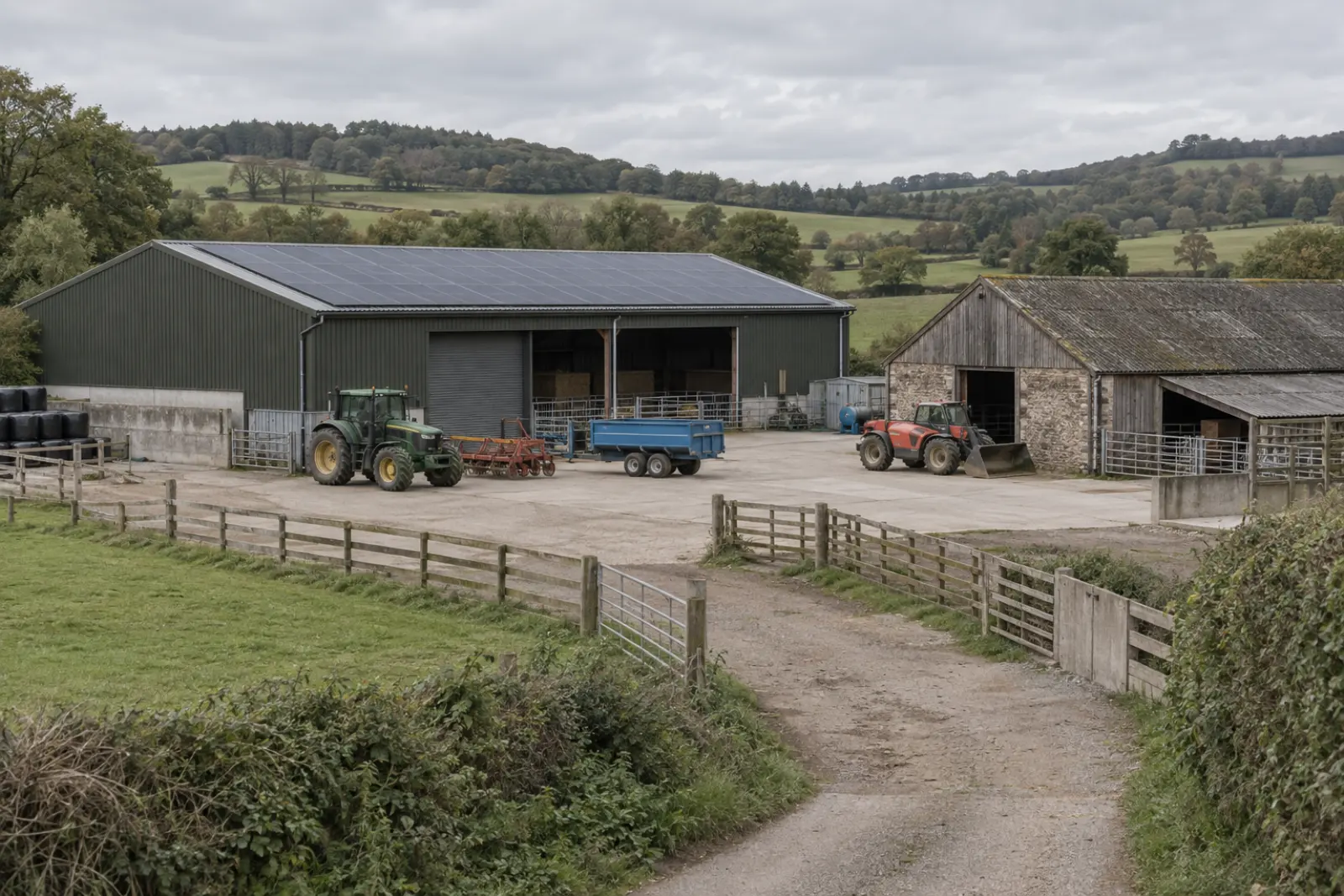
Farm building solar PV across Cambridgeshire
What a farm roof near Cambridge generates
Modelled irradiation at this latitude is 1160 kWh per square metre a year in the plane of a shallow-pitched roof, which works out at 906 kWh for every kWp installed (EU PVGIS v5.2, SARAH3, 10 degree pitch, 14 percent system loss). That sits within a few percent of the mean across the areas we cover, so what decides the scheme is your own demand pattern rather than the latitude.
3 roof mounted schemes are on record nearby. Roof arrays under a megawatt frequently never reach that database at all, so the real number of farm roofs generating around Cambridge is higher than the record shows.
We survey holdings across the CB postcode area, starting from CB1.
Cambridge is the planning authority for most holdings here, and it is the authority that decides whether an array on an agricultural building falls inside permitted development.
Cambridge ranks 2 of 8 towns we cover in Cambridgeshire on modelled yield, against a national mean of 886 kWh per kWp. The county runs from 898 to 908, a spread of 10 kWh per kWp. Within Cambridgeshire that difference is small enough to ignore: where the building sits is not what decides this scheme, your consumption pattern is.
Solar already consented near CB1
From the government's Renewable Energy Planning Database, Q1 2026. These are the schemes on record in this postcode district, which is a fair guide to how the local network has been treating export applications.
| Scheme | Operator | Capacity | Mounting | Status |
|---|---|---|---|---|
| St Bedes Inter-Church School | Solar Options for Schools | 1 MW | Roof | Awaiting Construction |
| Cambridge Parkside Pool | Cambridge City Council | n/a | Roof | Awaiting Construction |
| Coldhams Business Park, Norman Way - Solar Panels | Centrica Business Solutions | 0.5 MW | Roof | Awaiting Construction |
Grid connection through UK Power Networks
UK Power Networks operates the distribution network across Cambridgeshire, so the export application goes to them. Anything larger than 3.68 kW per phase falls under G99, which means an application before commissioning rather than a notification afterwards. A constrained network is not the end of a scheme. Capping export costs little when the building already absorbs most of what the roof produces.
Across Cambridgeshire the planning database records 172 solar schemes totalling 2422 MW, of which 46 are operational (REPD Q1 2026).
Send us the postcode
Tell us where the unit is and roughly how big the roof is. We come back with what it can carry, what it would generate against your consumption, and the three ways to pay for it.
Lenzie Consulting Ltd arranges the survey and passes your details to our MCS-certified installation partner so they can quote.
Questions about solar in Cambridge
- What would a 500 kWp array produce on a farm near Cambridge?
- Yes, and the figure matters more than the sunshine. At 906 kWh per kWp a year, a 500 kWp array on a Cambridge holding models at around 453,000 kWh. What changes the answer is how much of that the farm uses itself. Source: EU PVGIS v5.2, SARAH3, 10 degree pitch, 14 percent system loss.
- Which network operator handles the connection around Cambridge?
- Applications go to UK Power Networks, who run the network across Cambridgeshire. On a farm the incoming supply matters as much as their answer: a single phase supply caps what can be installed whatever the roof would take.
- What does Cambridge require for solar on an agricultural building?
- Roof-mounted panels on an agricultural building often fall under permitted development, subject to limits on projection above the roof plane and to the building not being listed or in a conservation area or National Park. We confirm the position with Cambridge before the design is finalised.
- Has anyone near CB1 already done this?
- The planning database records 0 ground mounted and 3 roof mounted solar schemes in this postcode district. That matters less as proof it works and more as evidence of how the local network has treated export applications. Roof arrays under a megawatt often never appear in the database, so the real figure is higher. Source: Renewable Energy Planning Database, Q1 2026.