Solar panels for farms in Aylesbury
Most holdings around Aylesbury already own the best generating site they will ever have, and it is the roof of the shed they built for something else. The survey starts on the covering: fibre cement or steel, its remaining life, the purlin spacing and what the frame will carry.
881 kWh per kWp a year at this latitude, so a 500 kWp array models at about 441,000 kWh. Source: EU PVGIS v5.2, SARAH3, 10 degree pitch, 14 percent system loss.
Book a roof survey in AylesburyIllustrative layout for a unit of this size. Your own figures come from the roof survey.
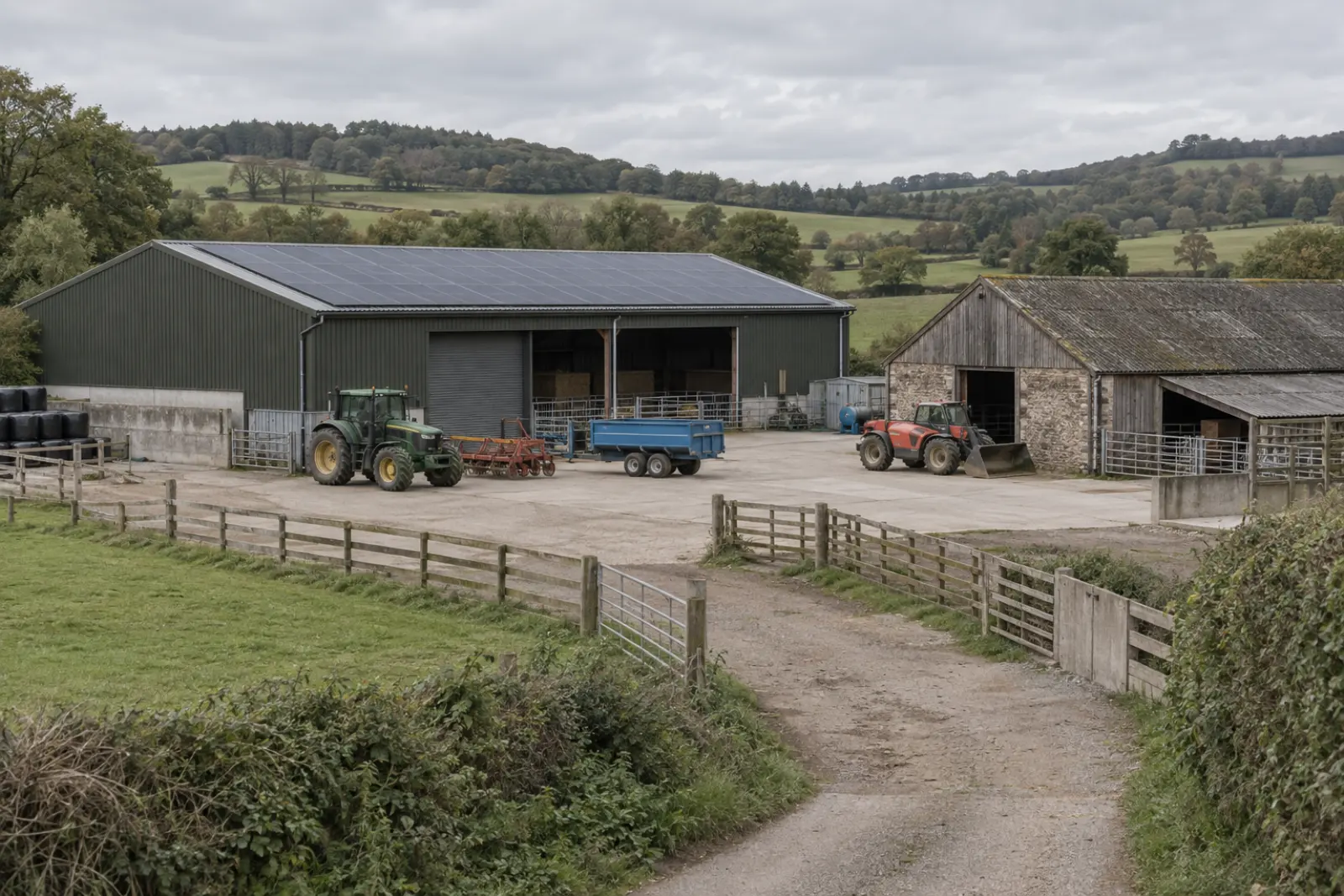
Solar for agricultural buildings across Buckinghamshire
What a farm roof near Aylesbury generates
Modelled irradiation at this latitude is 1129 kWh per square metre a year in the plane of a shallow-pitched roof, which works out at 881 kWh for every kWp installed (EU PVGIS v5.2, SARAH3, 10 degree pitch, 14 percent system loss). That sits within a few percent of the mean across the areas we cover, so what decides the scheme is your own demand pattern rather than the latitude.
1 roof mounted scheme is on record nearby. Roof arrays under a megawatt frequently never reach that database at all, so the real number of farm roofs generating around Aylesbury is higher than the record shows.
Surveys run across HP postcodes, HP21 outward.
Buckinghamshire is the planning authority for most holdings here, and it is the authority that decides whether an array on an agricultural building falls inside permitted development.
Aylesbury ranks 8 of 8 towns we cover in Buckinghamshire on modelled yield, against a national mean of 886 kWh per kWp. The county runs from 881 to 904, a spread of 23 kWh per kWp. Within Buckinghamshire that difference is small enough to ignore: where the building sits is not what decides this scheme, your consumption pattern is.
Solar already consented near HP21
From the government's Renewable Energy Planning Database, Q1 2026. These are the schemes on record in this postcode district, which is a fair guide to how the local network has been treating export applications.
| Scheme | Operator | Capacity | Mounting | Status |
|---|---|---|---|---|
| Aylesbury College Decarbonisation - Solar Panels | Aylesbury College | 0.54 MW | Roof | Awaiting Construction |
Grid connection through Scottish and Southern Electricity Networks
Connections around Aylesbury are handled by Scottish and Southern Electricity Networks, which sets the export limit for the site. Above 3.68 kW per phase the connection runs under G99, so the export limit is agreed in advance rather than assumed. Where the local network is constrained, an export-limited connection usually still makes the scheme work, because a farm uses most of what the roof makes during the working day.
Across Buckinghamshire the planning database records 127 solar schemes totalling 955 MW, of which 21 are operational (REPD Q1 2026).
Send us the postcode
Tell us where the unit is and roughly how big the roof is. We come back with what it can carry, what it would generate against your consumption, and the three ways to pay for it.
Lenzie Consulting Ltd arranges the survey and passes your details to our MCS-certified installation partner so they can quote.
Questions about solar in Aylesbury
- Is there enough sun around Aylesbury to make this work?
- Modelled at 881 kWh per kWp a year for a shallow-pitched roof at this latitude, which puts a 500 kWp array at roughly 441,000 kWh a year before shading. That array needs about 1,485 sqm of clear roof once ridge vents and walkways are allowed for. Source: EU PVGIS v5.2, SARAH3, 10 degree pitch, 14 percent system loss.
- Who do we apply to for export near Aylesbury?
- Only Scottish and Southern Electricity Networks can answer it for your connection, and on rural feeders the answer varies farm to farm. An export-limited offer usually still works, because a holding with grain drying, cooling or ventilation uses most of what it makes.
- Do we need planning permission in Buckinghamshire?
- In most cases no, because panels on the roof of an agricultural building usually sit within permitted development. The exceptions are listed buildings, conservation areas, protected landscapes and arrays that stand proud of the roof. We check with Buckinghamshire either way.