Solar panels for farms in Wallasey
Farm buildings around Wallasey carry broad, shallow roofs that were put up for storage and stock, not for generation. What decides a farm scheme here is the state of the roof sheets and the incoming supply, which is why the survey looks at both before anyone sizes an array.
862 kWh per kWp a year at this latitude, so a 500 kWp array models at about 431,000 kWh. Source: EU PVGIS v5.2, SARAH3, 10 degree pitch, 14 percent system loss.
Book a roof survey in WallaseyIllustrative layout for a unit of this size. Your own figures come from the roof survey.
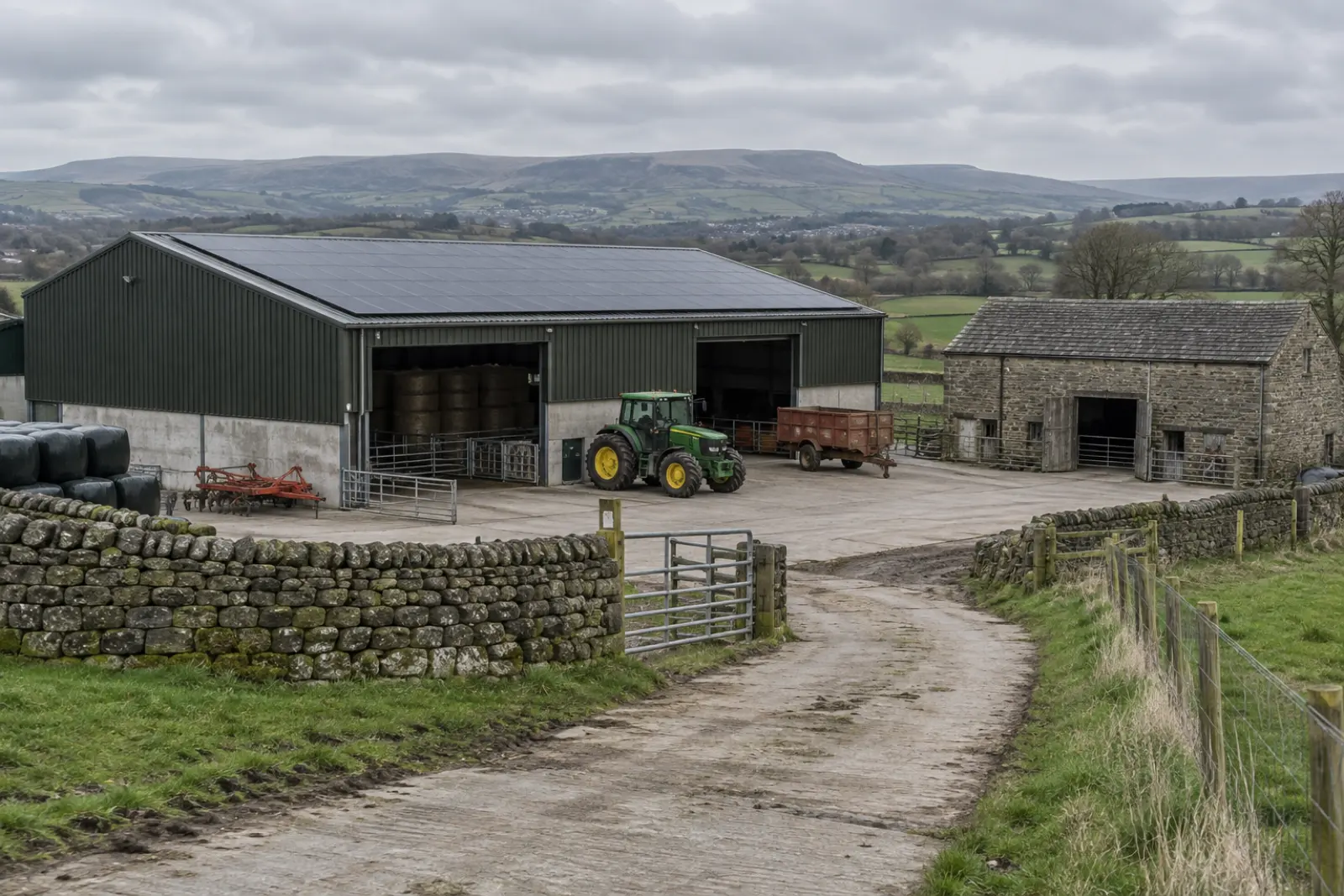
Agricultural rooftop solar across Merseyside
What a farm roof near Wallasey generates
Modelled irradiation at this latitude is 1098 kWh per square metre a year in the plane of a shallow-pitched roof, which works out at 862 kWh for every kWp installed (EU PVGIS v5.2, SARAH3, 10 degree pitch, 14 percent system loss). That sits within a few percent of the mean across the areas we cover, so what decides the scheme is your own demand pattern rather than the latitude.
No solar scheme is recorded in this postcode district in the planning database. On a farm that usually means nothing has been built above the reporting threshold rather than that nothing has been built, because a roof array on a shed rarely appears in it.
Most of the buildings we look at here sit in the CH postcode area.
Wirral is the planning authority for most holdings here, and it is the authority that decides whether an array on an agricultural building falls inside permitted development.
Wallasey ranks 2 of 6 towns we cover in Merseyside on modelled yield, against a national mean of 886 kWh per kWp. The county runs from 830 to 877, a spread of 47 kWh per kWp. On a 500 kWp array that is about 23,500 kWh a year between the strongest and weakest town in the county.
Grid connection through SP Energy Networks
SP Energy Networks is the network operator here, and their answer on export capacity shapes the design. Any commercial array above 3.68 kW per phase connects under G99 rather than G98, and the application fixes what you are allowed to push back onto the network. If the local network is tight, limiting export rarely breaks the case here: most of the generation is consumed on site while the building is working.
Across Merseyside the planning database records 104 solar schemes totalling 98 MW, of which 1 are operational (REPD Q1 2026).
Send us the postcode
Tell us where the unit is and roughly how big the roof is. We come back with what it can carry, what it would generate against your consumption, and the three ways to pay for it.
Lenzie Consulting Ltd arranges the survey and passes your details to our MCS-certified installation partner so they can quote.
Questions about solar in Wallasey
- What would a 500 kWp array produce on a farm near Wallasey?
- Yes, and the figure matters more than the sunshine. At 862 kWh per kWp a year, a 500 kWp array on a Wallasey holding models at around 431,000 kWh. What changes the answer is how much of that the farm uses itself. Source: EU PVGIS v5.2, SARAH3, 10 degree pitch, 14 percent system loss.
- Which network operator handles the connection around Wallasey?
- Applications go to SP Energy Networks, who run the network across Merseyside. On a farm the incoming supply matters as much as their answer: a single phase supply caps what can be installed whatever the roof would take.
- What does Wirral require for solar on an agricultural building?
- Roof-mounted panels on an agricultural building often fall under permitted development, subject to limits on projection above the roof plane and to the building not being listed or in a conservation area or National Park. We confirm the position with Wirral before the design is finalised.