Solar panels for farms in Cardiff Bay
A Cardiff Bay farm buys electricity at the worst rate of the day in exactly the hours its roof could be generating. What decides a farm scheme here is the state of the roof sheets and the incoming supply, which is why the survey looks at both before anyone sizes an array.
Book a roof survey in Cardiff BayIllustrative layout for a unit of this size. Your own figures come from the roof survey.
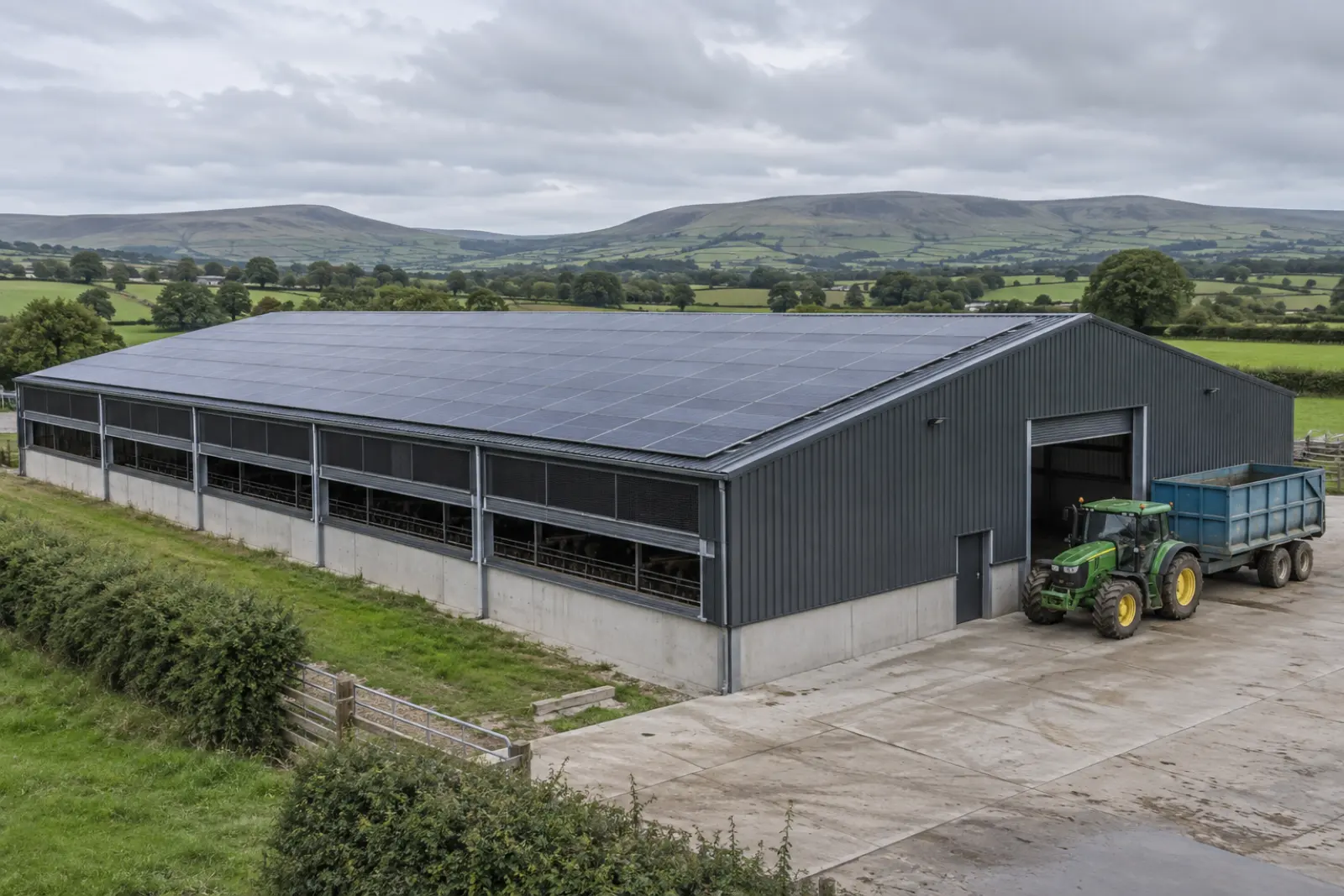
Agricultural rooftop solar across Cardiff
No solar scheme is recorded in this postcode district in the planning database. On a farm that usually means nothing has been built above the reporting threshold rather than that nothing has been built, because a roof array on a shed rarely appears in it.
Cardiff Bay ranks 0 of 4 towns we cover in Cardiff on modelled yield, against a national mean of 886 kWh per kWp. The county runs from 908 to 936, a spread of 28 kWh per kWp. Within Cardiff that difference is small enough to ignore: where the building sits is not what decides this scheme, your consumption pattern is.
Grid connection through National Grid Electricity Distribution
National Grid Electricity Distribution operates the distribution network across Cardiff, so the export application goes to them. Anything larger than 3.68 kW per phase falls under G99, which means an application before commissioning rather than a notification afterwards. A constrained network is not the end of a scheme. Capping export costs little when the building already absorbs most of what the roof produces.
Send us the postcode
Tell us where the unit is and roughly how big the roof is. We come back with what it can carry, what it would generate against your consumption, and the three ways to pay for it.
Lenzie Consulting Ltd arranges the survey and passes your details to our MCS-certified installation partner so they can quote.
Questions about solar in Cardiff Bay
- Who do we apply to for export near Cardiff Bay?
- Only National Grid Electricity Distribution can answer it for your connection, and on rural feeders the answer varies farm to farm. An export-limited offer usually still works, because a holding with grain drying, cooling or ventilation uses most of what it makes.